
Blogs
My Franchise Journey Started With One ‘What If’
It began in the third row of a school auditorium, with a paper cup of lukewarm tea and a phone I had forgotten to silence.
My son was four. He was on stage in a green felt costume, playing a tree, which required him to stand very still with his arms out and look serious. He did this with such total commitment that the entire audience was smiling. Beside me, a grandmother had her hand pressed to her mouth. In front of me, a father was filming with the careful, slightly trembling hands of someone trying not to cry.
I looked at the stage, at the teachers hovering at the wings with encouraging nods, at the faces of forty parents lit by a single thought, and a question arrived in my head that I did not invite.
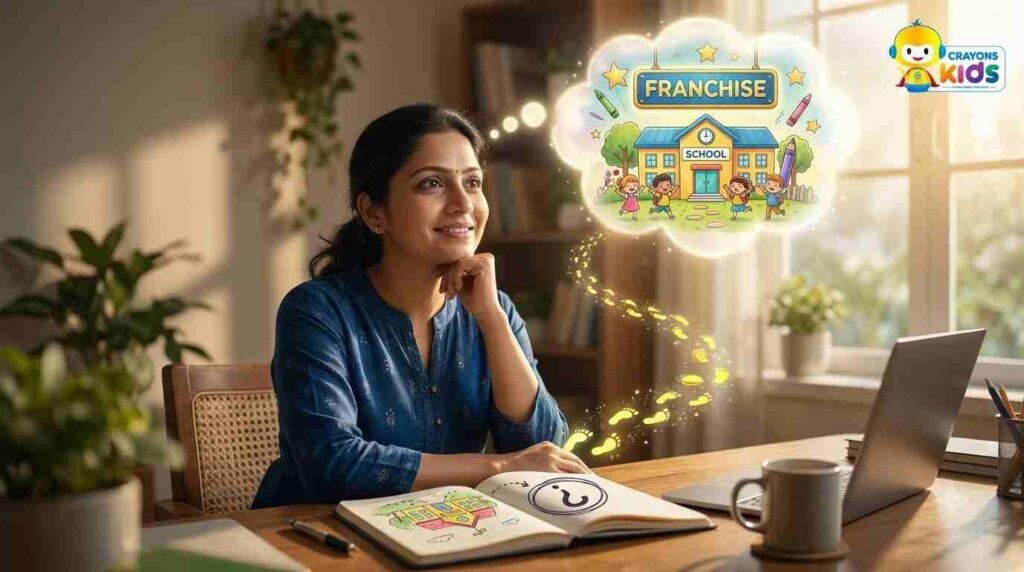
What if I built something like this?
That was all. Four words. And I have been living inside their consequences ever since.
The Question I Tried to Ignore
I should be honest about who I was that evening. I was thirty-four, working in operations for a logistics company, good at my job, tired most days and quietly restless. I had never run a business. I had never taught a class. I did not come from a family of entrepreneurs. My father, a government clerk, believed deeply in the word “stable.”
So I did what sensible people do with an absurd thought. I laughed at it, finished my tea and went home.
But the question did not leave. It followed me into the kitchen, into the car, into a Monday morning meeting about delivery schedules. Every time I saw a child laughing in a school bag with cartoon characters, the question came back. What if?
How One Question Became Many
What I did not understand then is that a “what if” never travels alone. It has a way of multiplying.
What if I look into it, just to see? Harmless.
What if there is something called a franchise, where you do not have to start from scratch? Curious.
What if the numbers actually make sense? Dangerous.
What if I could do this, and I never tried?
That last one was the real troublemaker. Because I realised, with some discomfort, that I was more afraid of that version of my life, the one where I never even asked, than of any failure I could imagine.
The Other Side of the ‘What If’
Of course, the question has a darker twin, and I met it that same week.
What if I fail?
What if I lose our savings?
What if I embarrass myself, my husband, my parents?
What if I am simply not the kind of person who does this?
I lay awake several nights, running the two lists side by side. The hopeful what-ifs and the frightened ones. They sounded almost identical in my head, and for a while, I could not tell which was louder.
Looking back, I think that is the real nature of a big decision. It is not a battle between courage and fear. It is a conversation between two kinds of imagination, and the work is deciding which one to take seriously.
Turning Imagination Into Research
I made a decision that changed everything. I stopped arguing with the “what ifs” and started answering them, one by one, with facts.
I read about preschool franchising. I spoke to people already doing it. I visited a Crayons Kids centre on a quiet Tuesday morning and watched a teacher calm a crying three-year-old in under two minutes. I asked questions about investment, break-even timelines and what happens when things do not go to plan.
What surprised me was how much a “what if” shrinks when you shine a light on it.
What if I do not know how to run a school? There was training, an operations framework and a team to call.
What if enrolments are slow? I was told, honestly, that early months often are, and shown how other owners had managed.
What if I cannot afford it? I sat with the numbers, did the arithmetic twice and drew a line around what we could responsibly commit.
Each answer did not eliminate the fear. It made it smaller and more specific, which made it manageable.
The Conversation With My Husband
The hardest “what if” to answer was the one I had to say aloud.
I told my husband on a Sunday evening, after dinner, over cold tea. I rehearsed it beforehand and delivered it badly. “I have been thinking about something,” I said. “It is going to sound strange.”
He listened to the whole thing without interrupting. When I finished, he was quiet for a long moment. Then he asked the question I had been most afraid of.
“What if it does not work?”
“Then we will have tried,” I said. “And we will have learned something. I have planned for it. I only want to risk what we can afford to lose.”
He thought about it. Then he said something I will carry for the rest of my life. “What if it does work, and we never tried?”
We looked at each other and laughed, because he had just handed my own dangerous question back to me.
The Night Before Signing
On the evening before I signed my franchise agreement, I sat on the floor of my son’s room while he slept. I listened to his breathing and thought about how small the beginning of all this had been: one boy dressed as a tree, one question in a school auditorium.
I was frightened, of course. But the fear had changed shape. It was no longer a vague cloud of what-ifs. It was a clear, specific, manageable awareness that I was about to do something difficult, with open eyes, with proper support and with the people I loved beside me.
I remember whispering to my sleeping son, “I hope I do this well.” Then I went to bed and slept better than I had in weeks.
What Happened After
I would love to say it was smooth. It was not.
The first year was slow, and tiring, and occasionally humbling. There were weeks when enquiries dried up. There was a tense afternoon with an unhappy parent, and a month when I questioned everything. There were nights I lay awake doing arithmetic.
But there was also a small boy, in month three, who stopped crying at the gate and walked straight in with a toy truck. A mother who told me, wiping her eyes, that her daughter had started singing in the car. A moment, one ordinary Thursday, when I walked into a classroom full of laughing children and realised I did not want to be anywhere else.
And through it all, the franchise support behind me held. Whenever I did not know what to do, someone did, and they were never more than a phone call away.
What I Know Now About ‘What If’
Looking back, I have come to see the question differently.
A “what if” is an invitation, not a decision. It does not demand that you act. It only asks you to look.
Looking costs very little. A few phone calls, a visit, a spreadsheet. You can look at almost anything without committing to it.
Fear and curiosity are both forms of imagination. The skill is in testing each against real facts rather than trusting the louder one.
The regret of never asking is real. Many of the people I now speak to carry a quiet “what if” they never explored. It is a heavier thing to carry than a failure.
You do not have to leap blindly. With honest information, careful planning and a real support system, the leap becomes a series of small, informed steps.
If You Are Holding a ‘What If’ Right Now
If something in this story made your chest tighten, if there is a question you have been carrying around for months, quietly asking yourself whether you could build something of your own, I want you to know that you do not have to answer it all at once.
You only have to take it seriously. Ask for the numbers. Visit a school. Speak to someone who has done it. Let your curiosity do a little honest research, and see what your fear has to say when it meets some facts.
You may discover that the question is not as foolish as you feared. Or you may discover that the answer is no, and walk away with clarity. Either is a good outcome.
Start With Your Own ‘What If’
Every Crayons Kids franchise begins somewhere small: a boy in a green felt costume, a conversation at a school gate, a question that will not go away. With proven systems, honest guidance and genuine franchise support, you do not have to answer it alone.
If you have been wondering whether a preschool franchise might be right for you, we would love to talk, and to answer every question, including the uncomfortable ones. Enquire about franchise opportunities today, and take the first step from “what if” to “what next.”