
Blogs
Why I Saved My Child’s First Art Project
It is a paper plate with a face on it.
The face belongs to a lion, or so I have been told. The mane is made of dried pasta spirals, glued on in a ring so uneven that one side looks like a hedge and the other like a receding hairline. One eye is a large black circle. The other is a smaller circle, slightly lower, which gives the lion a look of permanent, mild surprise. The nose is a triangle of orange paper held on with an astonishing amount of glue, and a few pieces of pasta have fallen off since it came home, because glue and pasta are not natural allies.
It sits in a flat cardboard box on the top shelf of my cupboard. It is the first art project my daughter ever brought home from preschool, and I would rescue it before almost anything else I own.
The Afternoon It Arrived
I remember exactly how it came into my life.
It was the end of her second week. I was standing at the gate in the late afternoon heat, scanning the doorway for a small figure in a too-large uniform. She came out holding her teacher’s hand, clutching something flat against her chest with both arms, as though it were a living creature she had been told not to drop.
“Amma,” she said, before she even reached me, “I made something. You are not allowed to look until we get home.”
She held it against her the whole way. In the car, she refused to put it on the seat. At home, she walked into the living room, arranged herself on the sofa, instructed me to sit and close my eyes, and then, with the grave ceremony of someone unveiling a statue, she presented me with the lion.
“Open,” she said.
I opened my eyes. I looked at a paper plate with pasta glued around its edge and a face that was, frankly, slightly alarming. And I saw, in the shaky black line of the mouth, in the glue that had pooled around the nose, in the place where a small thumbprint had pressed into the orange paper, something I did not have words for. I just knew that it was the most important thing anyone had ever handed me.
“It is a lion,” she said, anxiously, because I had not spoken yet. “Do you like him?”
“I love him,” I said, and I meant it more than I could explain.
The Question I Asked Myself That Night
That evening, after she was asleep, I stood in the kitchen holding the plate and faced a practical problem.
I did not know what to do with it.
It was fragile. It was clumsy. It had pasta shedding onto the counter. By any ordinary household logic, it belonged in the bin. We were a family living in a small flat, and I had already begun to understand that a child’s school bag is a conveyor belt of paper, and that if you kept everything, you would eventually be unable to open the door.
But I could not throw it away. And, standing there in the half-light, I tried to work out why.
I have thought about it a great deal since, and I have come to some answers.
Reason One: It Was Made by Her Hands
The first reason is the simplest.
She made it. Not a machine, not a shop, not an adult. A three-year-old, with a pot of glue and a handful of pasta, sat at a table somewhere I could not see, and decided where every piece should go.
Look closely at a first art project and you can read her hands. The pressure of the crayon. The way she chose to start at the top. The thumbprint pressed into the paint. These are fingerprints in the most literal sense, a record of a particular small body at a particular moment in time.
Photographs show us what children look like. Art shows us what they did. That difference matters more with every passing year.
Reason Two: It Is a Snapshot of How She Thought
I was struck, looking at that lion, by how much of her mind was visible in it.
The mane was a ring because she saw lions as round. The two uneven eyes were not an error. They were an expression: she had decided the lion was surprised. The pasta she had chosen, spirals rather than tubes, told me she liked things that curled.
When I asked her about it later, she explained that the lion was “friendly, but a bit scared of the bees.” This detail appeared nowhere on the plate. It lived only in her head.
A first art project is a window into a way of seeing that will not last. In a year, her lions will have proper proportions. In two, they will have shading. By ten, she will draw them perfectly, and the strange, wonderful logic of the pasta mane will be gone. I wanted to keep a record of the last moment when a lion could be friendly and nervous and made of spirals, all at once.
Reason Three: It Was Proof That Someone Noticed Her
There was something else, harder to name, that I understood only a few weeks later.
During a parent conversation, her teacher mentioned the lion. “She worked on that for nearly forty minutes,” she said. “She would not let anyone help. When the pasta fell off, she asked for more glue and started again. I had to resist the urge to tidy it up.”
I stared at her. Forty minutes. My daughter, who could not sit through a short story, had spent forty minutes on a paper plate.
“I did not correct a single thing,” her teacher added. “I wanted it to be completely hers.”
That sentence changed how I looked at the plate. It was not simply my daughter’s work. It was evidence that, in a room full of children, a patient adult had seen what she was doing, guarded it from interference and allowed it to be entirely her own. In an environment designed to give children room to create without correction, the lion was a small monument to being trusted.
That is a gift worth keeping.
Reason Four: It Marks the Beginning of Something
The first of anything carries a particular weight. First steps. First words. First days of school.
A first art project is the first thing a child makes in a world outside the home, for people other than her parents. It is the beginning of her creative life beyond us. And like all beginnings, it will never come again.
I did not understand this when my daughter was three. I understand it now that she is eight, and her drawings are nuanced, confident and slightly bored of lions. When I take the old plate out of its box, I do not see an artwork. I see a doorway to the exact afternoon she became an artist, though neither of us would have said so then.
What I Did With It
Because I know many parents stand at the same kitchen counter, I will share what I did, in case it helps.
I photographed it first. Before anything else, I took several photographs from the front and the side, with her standing beside it. The picture is a backup, and a reminder of her size at the time.
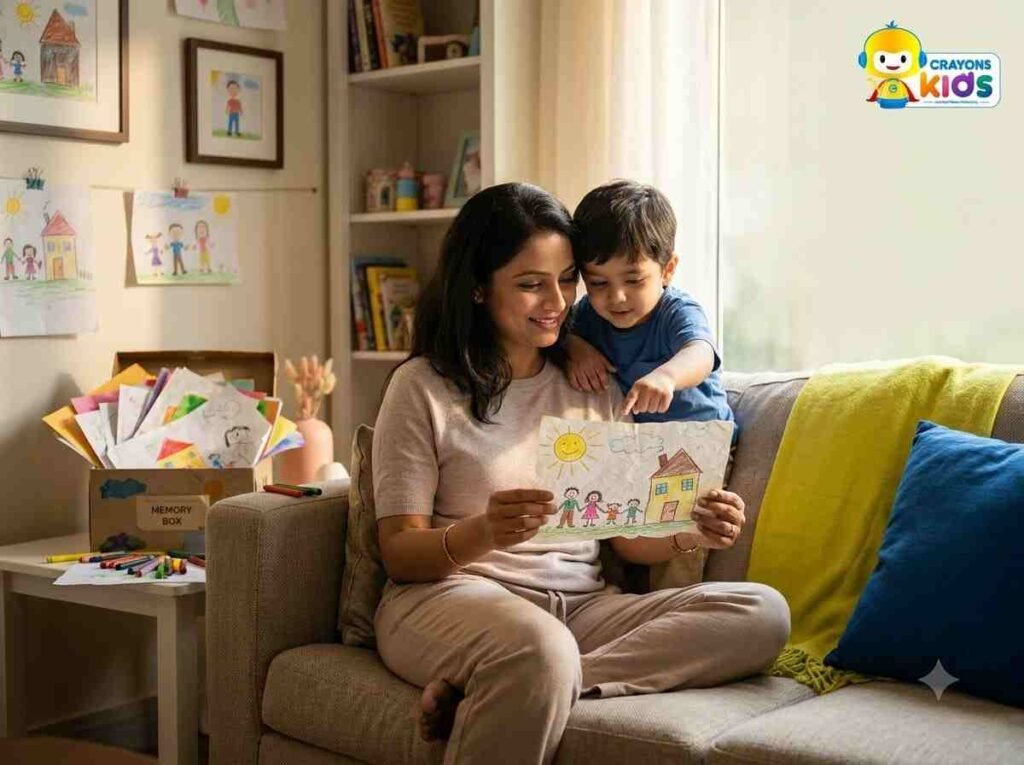
I kept the original in a flat box. I chose a shallow, acid-free cardboard box, the kind sold for documents, so the plate could lie flat. I laid it on a sheet of tissue paper. It has survived five years.
I wrote on the back. In pencil, small, in one corner: her name, her age, the date and one sentence she said about it. “Friendly lion, scared of bees.” In ten years, that sentence will be worth more than the plate.
I kept only a few. I am not a hoarder, and I did not keep everything. Each term, my daughter and I choose three favourites together. The rest, after a week on the fridge, we photograph and let go. Letting go is easier when you have kept the best.
I let her choose. This was the most important rule. She decides what stays. She has surprising instincts. Some elaborate paintings did not make the cut. A scribbled card with three stars did.
When You Cannot Keep Everything
Every parent I know has the same dilemma: the stream of paper never stops. If you want practical ideas, a few have worked for friends of mine.
Create a digital gallery. A quick photo of each piece, filed by year. It costs nothing, takes no space and lets you revisit everything.
Make a yearly book. Many services print a small photo book of a child’s artwork. Giving one to grandparents is a gift that never gets old.
Frame one at a time. A rotating frame on the wall lets a favourite hang for a month and then be replaced.
Repurpose with care. Some drawings can become a card, a calendar page or a bookmark. They live on in a form that gets used.
Be gentle about letting go. Do not throw things away in front of your child. Let them leave quietly, after a decent interval on the fridge.
What the Plate Teaches Me Now
When my daughter was in the lion phase, I thought I was keeping an artwork. I now think I was keeping a lesson.
The lesson is that children’s work is not primarily about the result. It is about the process, the trust and the small, brave act of making something and offering it to another person. A plate with uneven eyes does not need to be good. It needs to be received.
Every time my daughter hands me something she has made, I now stop what I am doing. I ask her to tell me about it. I do not correct, and I do not improve. I simply say, “Tell me more.” And her face, every time, lights up the way it did the day she unveiled the lion.
That is what I saved, in the end. Not the paper plate. The look on her face when I did not laugh.
The Plate Is Still in the Box
A few weeks ago, on a rainy Sunday, my daughter found the box while looking for something else. She lifted the tissue paper, saw the lion and went quiet.
“Amma,” she said, “I made this?”
“You did.”
She studied it for a long moment, the surprised eye, the hedge-like mane, the triangle nose. Then she said, with the solemn amusement of an eight-year-old looking at an earlier self, “He looks very silly.”
“He does,” I agreed. “I love him.”
She smiled, carefully put the lid back on the box and placed it on the shelf herself, a little higher than I had.
Give Your Child a Place Where Every Creation Is Welcome
At Crayons Kids, we believe that a child’s first art project is never just a craft. It is the first small proof that her ideas matter. Our teachers give children room to make, mess and decide for themselves, and they celebrate every wobbly line with genuine delight.
If you are searching for a preschool where your child’s creativity is protected rather than corrected, we would love to welcome your family. Book a campus visit today, meet our teachers, and see how we help every little artist feel seen. Enquire about admissions today.