
Blogs
Best Preschool Franchise in India 2026
India’s preschool and childcare market crossed roughly USD 5.1 billion in 2025 and is projected to reach USD 12 billion by 2034, growing at over 9% a year. That is not a small, niche category anymore — it is one of the fastest-expanding segments of India’s broader education economy, fuelled by rising dual-income households, growing awareness of early-childhood development, and a generation of parents who see preschool not as daycare but as the foundation of a child’s entire learning journey.
That growth is exactly why so many first-time entrepreneurs and career-break professionals are searching for the best preschool franchise in India right now. A franchise model offers something a from-scratch school cannot: a tested curriculum, an established brand, and a support system that shortens the distance between “I want to start a school” and “I have a profitable, well-regarded centre in my neighbourhood.”
But here is the part most first-time franchise owners get wrong: “best” doesn’t mean the biggest name with the most branches. It means the franchise that gets you to profitability fastest, with the least ongoing financial drag, and with a curriculum and support system strong enough that parents keep choosing you over the five other preschools within a two-kilometre radius.
This guide walks through exactly what separates a genuinely good preschool franchise from one that simply has good marketing.
Why the Preschool Boom Doesn’t Automatically Mean Franchise Success
It is tempting to look at a 9%+ CAGR and assume that opening any preschool in any location under any brand will work out. It won’t. Market growth tells you that demand exists — it says nothing about whether a specific franchise agreement will actually let you capture that demand profitably.
Three things determine whether you personally succeed inside a booming market:
- How much of your revenue you actually keep, after royalties, marketing fees, and mandatory purchases from the franchisor.
- How differentiated your centre is in a neighbourhood where three or four other preschools are also chasing the same 200–300 families within pram-pushing distance.
- How much operational support exists once the ribbon-cutting photos are done and you’re the one handling a teacher resignation in month four.
Most franchise comparisons online focus only on brand recognition and total investment. Those matter, but they are the least useful numbers if you don’t also understand the fee structure and the support system behind them.
What Actually Makes a Preschool Franchise “The Best”
Four things matter more than brand size: curriculum quality, the fee structure the franchisor charges you, the support you get after signing, and how well the brand fits the neighbourhood you’re opening in. A franchise with 500 centres but a 14% royalty on your revenue can be a worse deal than a smaller, well-run brand with zero ongoing fees. Let’s break each of these down in detail, because each one has a direct, compounding effect on your bottom line.
1. Curriculum Quality and Alignment with NEP 2020
A preschool’s curriculum is its actual product. Everything else — the branding, the interiors, the marketing — exists to get parents through the door so the curriculum can do its job of retaining them for the next three to four years.
Since the National Education Policy (NEP) 2020 formally brought early childhood care and education (ECCE) into the foundational stage of schooling, parents have become noticeably more curriculum-literate. They ask about play-based learning, foundational literacy and numeracy goals, and whether a centre’s approach is aligned with NEP’s framework rather than being a repackaged daycare programme. A franchise whose curriculum was designed — and is periodically updated — around these guidelines gives you a genuine talking point in admissions conversations, not just a brochure claim.
Look for curriculum structures that are built around distinct, well-defined pillars (language, numeracy, STEM/STEAM exposure, creative and enrichment programming) rather than a single generic “activity-based learning” pitch that could describe almost any preschool in the country.
2. The Fee Structure the Franchisor Charges You
This is the single most under-examined factor in preschool franchise decisions, and it deserves the most scrutiny.
Most preschool franchises in India run on a revenue-share model, typically 10–15% of monthly fee collections, paid to the franchisor indefinitely — for as long as you operate the centre. On the surface, a royalty feels manageable when you’re looking at it as a percentage. In practice, over a 10-year centre life, that adds up to a significant share of your total revenue leaving the business every single month, regardless of how well or poorly the centre is performing that month.
Think about what that means in a slow month — say, during school-holiday enrolment dips, or in your centre’s first year while you’re still building a waitlist. You are still handing over 10–15% of whatever you did collect, on top of rent, teacher salaries, utilities, and marketing spend. It is a fixed percentage drag on a variable, and often unpredictable, revenue line.
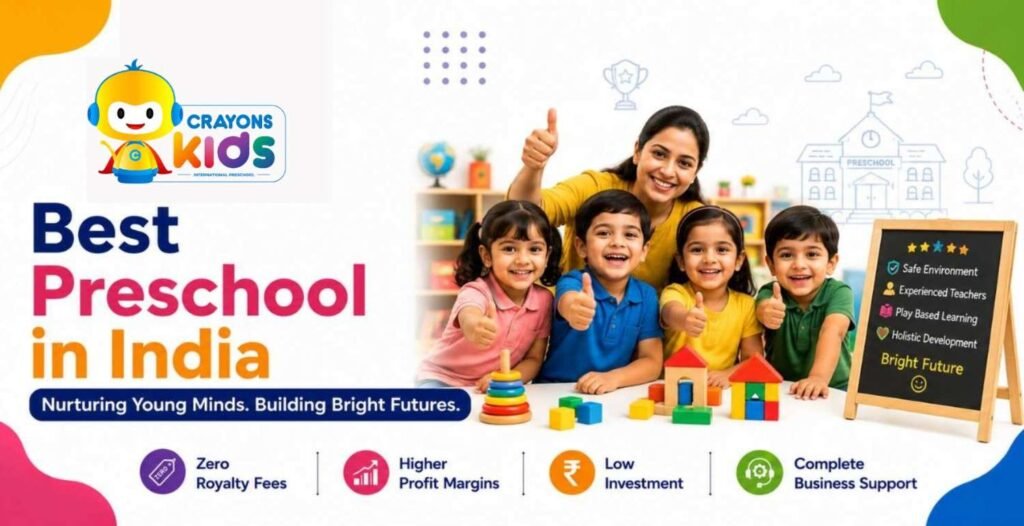
Compare that to a model with zero monthly royalty. Crayons Kids takes exactly this approach: you pay a one-time franchise investment and keep everything you earn after that. This single structural difference changes the entire economics of ownership, especially in the first 24 months when every rupee of cash flow matters most — the period when you’re still paying off setup costs, building your local reputation, and figuring out your actual break-even enrolment number.
When you’re comparing franchises, don’t just ask “what’s the royalty percentage.” Ask for a 5-year and 10-year cumulative royalty projection based on realistic (not best-case) enrolment numbers, and compare that figure against the one-time investment of a zero-royalty alternative. The math often surprises people.
3. Post-Signing Support: Where Most Franchise Relationships Actually Get Tested
The sales conversation before you sign is almost always excellent. Every franchisor will tell you about training, marketing support, and “we’re with you every step of the way.” The real test is what happens in month six, when you have a teacher who’s underperforming, an admissions dip because a competing centre opened two streets away, or a compliance question about a state-specific childcare regulation.
Ask specifically about:
- Teacher training — is it a one-time onboarding session, or an ongoing programme with refreshers and classroom observation?
- Admissions and marketing support — does the franchisor provide creative assets, local digital marketing guidance, or lead-generation support, or are you entirely on your own for enrolment?
- Operational troubleshooting — is there a dedicated point of contact for franchisees, or a generic support email that takes a week to respond?
- Curriculum updates — does the brand actively refresh its programme as educational standards evolve, or has the curriculum been unchanged since the franchise launched?
A franchise’s answers to these questions — and more importantly, what existing franchisees say about them — tell you far more about long-term viability than the number of centres on the brand’s website.
4. Neighbourhood Fit
A premium, English-medium, activity-heavy preschool brand will thrive in an upper-middle-class residential pocket and struggle in a price-sensitive suburb where parents are comparing monthly fees down to the hundred-rupee mark. Conversely, a budget-positioned brand will feel underwhelming to parents in a neighbourhood where three other preschools already offer air-conditioned smart classrooms and structured STEM programming.
Before signing with any franchise, walk the actual streets around your proposed location. Count the competing preschools within a 10–15 minute radius. Note their fee ranges, their infrastructure, and — if you can get it — their approximate enrolment. Then ask yourself honestly whether the franchise brand you’re considering would look like a step up, a lateral move, or a step down to the parents in that specific pocket. “Best” is not a universal ranking; it’s a fit between brand positioning and local market expectations.
Curriculum and Brand Differentiation: A Closer Look at Crayons Kids
Crayons Kids has been operating for over a decade, with 40+ schools and 5,000+ children across South India — a track record that gives prospective franchisees real operating history to evaluate, rather than a pitch deck built on projections alone.
The curriculum is built on the ICAN Learning System and five core pillars — Spiral, STEAM, Math, Language, Enrichment, and Creativity programs — aligned with NEP 2020’s foundational-stage guidelines. Because the curriculum is spiral in structure, concepts are revisited and built upon across the academic year rather than taught once and left behind, which is a meaningfully different pedagogical approach from the linear, unit-based curricula many budget preschool brands use.
The brand has also picked up recognition including The Economic Times Best Education Brands (2022) and the Times Education Icon Award. Awards alone shouldn’t be the deciding factor in a franchise decision, but they matter practically, too: when you’re pitching the school to parents comparing five other centres in the same locality, third-party recognition gives you an easy, credible answer to “why should I choose you over the preschool down the road.”
What to Evaluate Before You Commit to Any Brand
Regardless of which franchise you’re leaning toward, treat the decision with the same diligence you’d apply to any six- or seven-figure business investment — because that’s exactly what it is. Ask every franchisor you’re considering:
- What is the total investment, including interiors, equipment, and working capital — not just the headline franchise fee?
- Is there a monthly or annual royalty, and if so, what percentage, and is it calculated on gross collections or net revenue?
- What training do teachers receive, both at launch and on an ongoing basis?
- How is admissions marketing handled — does the franchisor provide support, or is lead generation entirely your responsibility?
- What is the actual break-even timeline reported by existing franchise owners — not projected by the sales team, but the real, on-the-ground experience of centres that opened one, two, or three years ago?
Get these answers in writing before you sign anything. A franchisor confident in their model will have no hesitation putting these details in your franchise agreement or a formal disclosure document. Hesitation or vague answers on any of these points is itself useful information.
Red Flags to Watch For
A few warning signs are worth flagging explicitly, because they show up repeatedly in preschool franchise complaints across India:
- Break-even projections with no supporting data. If a franchisor gives you a break-even timeline but can’t connect you with an existing franchisee to verify it, treat the number as marketing, not fact.
- Royalty structures buried in fine print. Some agreements describe the royalty as a flat administrative fee in the sales pitch, but the actual contract calculates it as a percentage of gross revenue. Always read the contract, not just the brochure.
- Mandatory procurement clauses that force you to buy furniture, learning materials, or uniforms exclusively from the franchisor at above-market rates, effectively functioning as a hidden second royalty.
- No exit or renewal clarity — understand what happens to your centre, your goodwill, and your enrolled families if you or the franchisor choose not to renew the agreement after the initial term.
Where Crayons Kids Fits into This Decision
Crayons Kids was built specifically around the neighbourhood-school model: premium, NEP-aligned early education within 10 minutes of where families already live, backed by a zero-royalty structure that protects your margins as you grow. For a first-time entrepreneur, that combination — an established, awarded curriculum paired with a fee structure that doesn’t erode your revenue month after month — directly addresses the two biggest risks in preschool franchising: weak differentiation and slow, royalty-eroded profitability.
If you’re comparing franchise options, it’s worth getting a personalised investment breakdown before deciding, factoring in your specific city, locality, and the competitive landscape around your proposed centre. Generic national averages rarely reflect what a centre in your actual neighbourhood will cost to set up or how quickly it can realistically fill its waitlist.
Making the Final Decision
There is no single “best” preschool franchise that’s right for every investor in every city. The right choice depends on your budget, your risk tolerance, the competitive density in your chosen locality, and how much ongoing revenue share you’re willing to give up in exchange for brand recognition. What should guide your decision is not the size of the franchise’s logo, but the honest answers to the questions above: the real total investment, the real royalty structure, the real support you’ll get after signing, and the real break-even experience of people who’ve already done what you’re about to do.
Ready to see the numbers for your city? Ask for a Crayons Kids franchise and our team will walk you through investment, support, and timelines specific to your location.