
Blogs
Preschool Franchise Cost in India: The Complete Investment Guide (2026)
India’s preschool and childcare market crossed roughly USD 5.1 billion in 2025 and is projected to reach USD 12 billion by 2034, growing at over 9% a year. That growth is exactly why so many first-time entrepreneurs and career-break professionals are searching for preschool franchise cost in india and trying to work out whether this is the right franchise business india opportunity for them.
But cost alone doesn’t tell the full story. A preschool franchise investment decision has to weigh the upfront number against the ongoing fees, the support you get, and how quickly the centre can realistically break even in your specific city. This guide walks through every part of that calculation.
Understanding Preschool Franchise Cost in India
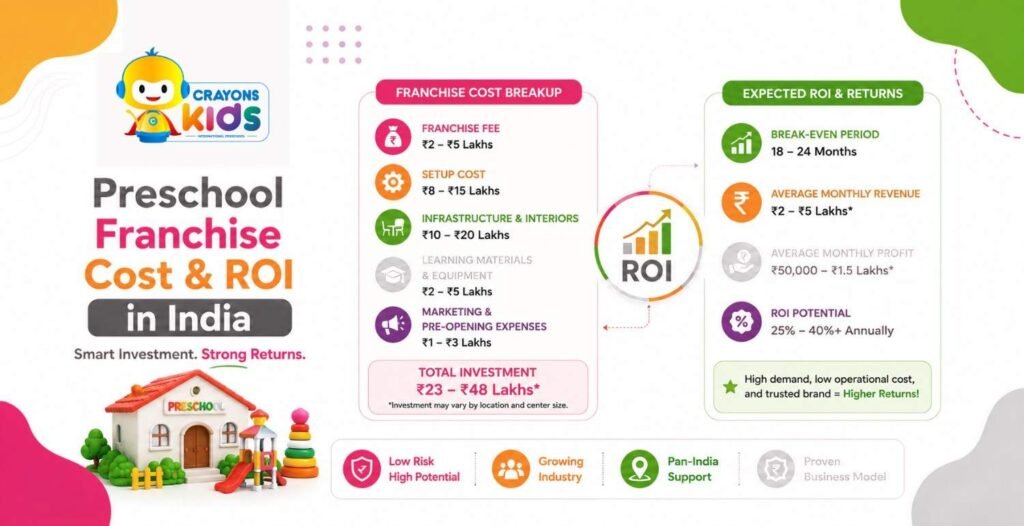
When people first search for preschool franchise cost in india, they’re usually looking for a single number. In reality, the total preschool startup cost india is made up of several components, and skipping any one of them in your planning is how first-time owners run out of working capital in month four.
The typical cost stack includes:
- Franchise fee — the one-time amount paid to license the brand, curriculum, and systems
- Interiors and infrastructure — flooring, furniture, safety fittings, classroom setup, and play areas
- Learning materials and equipment — books, STEM kits, toys, and teaching aids specified by the franchisor
- Working capital — enough cash reserve to cover 6–12 months of rent, salaries, and utilities before enrolment reaches a stable level
- Marketing and launch costs — local advertising, signage, and admissions-drive spend for your opening intake
Any franchisor who quotes you only the first item and calls that your preschool franchise cost in india is giving you an incomplete picture. Ask for a full, itemised breakdown before you commit any funds. You can get a detailed cost breakdown from Crayons Kids for your specific city and locality before making a decision.
Preschool Franchise Investment vs. Preschool Business Cost: What’s the Difference
These two phrases get used interchangeably, but they mean slightly different things in practice.
Preschool franchise investment refers to what you pay a franchisor to operate under their brand — the licensing fee, mandatory design and material standards, and any deposit tied to the franchise agreement itself.
Preschool business cost, on the other hand, is the full picture of what it costs to actually run the centre — rent, staff salaries, utilities, maintenance, and the ongoing share of revenue (if any) that goes back to the franchisor every month.
This distinction matters because a franchise with a low upfront preschool franchise investment can still turn into a high-cost preschool business over time if it carries a heavy ongoing royalty. Conversely, a franchise with a slightly higher entry cost but zero royalty preschool franchise terms can end up being dramatically cheaper to run over a 5–10 year period. Always model both numbers — day-one investment and year-five cumulative cost — before comparing brands.
Why the Royalty Structure Is the Most Important Number in Any Preschool Franchise Fees Comparison
Most preschool franchise fees in India include a recurring royalty, typically 10–15% of monthly fee collections, paid to the franchisor indefinitely for as long as you operate the centre. Over a 10-year centre life, that adds up to a significant share of your total revenue leaving the business every single month, regardless of how well or poorly the centre is performing that month.
This is where Crayons Kids takes a fundamentally different approach: zero monthly royalty, ever. As a genuine zero royalty preschool franchise, you pay a one-time franchise investment and keep everything you earn after that. This single structural difference changes the entire economics of ownership — especially in the first 24 months, when every rupee of cash flow matters most and you’re still building toward a full waitlist.
If you’re comparing a low investment preschool franchise against a zero royalty preschool franchise, don’t just look at the entry price. Project both models out five and ten years using realistic enrolment numbers. In most cases, the zero-royalty structure wins decisively once you account for the cumulative revenue share a percentage-based model would have taken.
Is a Preschool Franchise a Profitable Business Opportunity?
Whether a preschool franchise is a profitable preschool franchise depends on three variables you control and one you mostly don’t:
- Location density — how many families with young children live within a 10–15 minute radius of your centre
- Fee positioning — whether your pricing matches what local parents are used to paying for quality early education
- Cost discipline — how tightly you manage staffing, rent, and marketing spend against your enrolment curve
- Local competition — the one factor you can research but not fully control
A well-run centre under an established, NEP-aligned brand with a zero monthly royalty structure has a real structural advantage here, because more of every fee rupee collected stays in your business rather than flowing back to a franchisor. That advantage compounds every single month you’re operational, which is why so many owners describe this as one of the more genuinely profitable preschool franchise categories in the broader education franchise investment space, provided the brand and location are right.
Childcare Franchise Cost by Investment Tier
Depending on brand positioning, city, and centre size, childcare franchise cost in India typically falls into a few broad bands:
- Budget/entry-level brands — lower franchise fees, smaller centres, minimal infrastructure requirements, but often thinner brand recognition and support
- Mid-market brands — moderate investment, structured curriculum, reasonable support systems, positioned for aspirational middle-class neighbourhoods
- Premium brands — higher upfront investment, strong curriculum credentials, brand recognition, and typically stronger long-term retention because parents perceive higher value
A low investment preschool franchise in the entry tier might look attractive on day one, but if it lacks curriculum depth or brand recognition, it can struggle to fill seats in a neighbourhood where three other centres already have waitlists. Meanwhile, a mid-to-premium brand with a zero royalty structure — rather than a lower entry fee plus an indefinite revenue share — often delivers a better total return, because you’re not perpetually giving up a slice of every fee collection.
Before deciding purely on the lowest sticker price, get a personalised investment breakdown from Crayons Kids so you can compare like-for-like against your actual city and locality, rather than relying on generic national averages.
Preschool Franchise South India: Regional Demand and Positioning
Demand for quality early education has grown particularly fast across South India, driven by higher dual-income household density, strong awareness of NEP 2020’s foundational-stage guidelines, and parents actively comparing curriculum quality rather than choosing purely on price. This makes preschool franchise south india searches some of the highest-intent queries in the category — people aren’t just browsing, they’re actively evaluating brands to invest in.
Within this region, preschool franchise hyderabad and preschool franchise telangana searches specifically reflect the city’s fast-growing residential corridors, where new gated communities and apartment complexes are creating fresh pockets of demand for a preschool within a short walk or drive of home. If you’re evaluating a location in this market, look closely at which established brands already have a track record in South India specifically, rather than a brand whose only centres are concentrated in a different part of the country with different parent expectations and price sensitivity.
Crayons Kids has been operating for over a decade, with 40+ schools and 5,000+ children across South India — giving prospective franchisees in Hyderabad, Telangana, and neighbouring markets a real, regional operating history to evaluate rather than a national pitch deck built on projections from an unrelated market.
Crayons Kids Franchise: Curriculum, Recognition, and the Zero-Royalty Model
For anyone specifically researching a crayons kids franchise, here’s what differentiates the model from most other options in the education franchise investment category:
The curriculum is built on the ICAN Learning System and five core pillars — Spiral, STEAM, Math, Language, Enrichment, and Creativity programs — aligned with NEP 2020’s foundational-stage guidelines. Because the curriculum is spiral in structure, concepts are revisited and built upon across the academic year, which is a meaningfully different pedagogical approach from the linear, unit-based curricula many budget preschool brands rely on.
The brand has also picked up recognition including The Economic Times Best Education Brands (2022) and the Times Education Icon Award — third-party validation that matters when you’re pitching the school to parents comparing five other centres in the same locality.
And on the financial side, the crayons kids franchise model is built around zero monthly royalty, ever, positioning it as one of the more straightforward preschool franchise fees structures available: a one-time investment, and everything you earn after that stays with you.
Preschool Business Model: What to Understand Before You Commit
A strong preschool business model rests on four pillars, and it’s worth evaluating any franchise against all four before signing:
- Curriculum quality — is it genuinely NEP-aligned and structured for progressive learning, or a generic activity calendar?
- Fee structure — what is the full preschool franchise fees picture, including any recurring royalty or mandatory procurement costs?
- Post-signing support — what training, marketing help, and operational troubleshooting does the franchisor actually provide once you’re running day-to-day?
- Neighbourhood fit — does the brand’s positioning (premium, mid-market, budget) match what parents in your specific locality expect and are willing to pay for?
Ask every franchisor you’re considering: what is the total investment including interiors and working capital, is there a monthly or annual royalty, what training do teachers receive, how is admissions marketing handled, and what is the actual break-even timeline reported by existing franchise owners — not projected by the sales team. Get these answers in writing before you sign anything.
Where Crayons Kids Fits Into This Decision
Crayons Kids was built specifically around the neighbourhood-school model: premium, NEP-aligned early education within 10 minutes of where families already live, backed by a zero-royalty structure that protects your margins as you grow. For anyone weighing a preschool franchise investment, a childcare franchise cost comparison, or specifically researching preschool franchise hyderabad or preschool franchise telangana options, that combination directly addresses the two biggest risks in the category: weak differentiation and slow, royalty-eroded profitability.
If you’re comparing franchise options, it’s worth getting a personalised investment breakdown before deciding, factoring in your specific city, locality, and the competitive landscape around your proposed centre.
Ready to see the numbers for your city? Ask for a Crayons Kids franchise and our team will walk you through investment, support, and timelines specific to your location.