
Blogs
My Child’s First Words About Preschool
For the first four days of preschool, my son told me nothing at all.
I asked, of course. I asked in the car, over dinner and at bedtime, in every tone I could muster, from casually curious to gently pleading. “How was school today?” “What did you do?” “Did you make a friend?” Each time, he looked at me with the vague, slightly pitying expression of a person being asked to explain the ocean, shrugged, and returned to his toy truck.
I told myself this was normal. Everyone says a toddler’s silence about school is normal. But on the fifth day, as I tucked him into bed and heard nothing again, I felt a small, hollow ache. I realised I was starving for information about a place I could not see, and the only person who could tell me about it was three years old and uninterested.
Then, on the sixth day, he spoke.
Six Words in the Dark
It happened at bedtime, in the soft, sleepy quiet when children say the most surprising things. I had turned off the main light, switched on his small night lamp and was pulling his blanket up to his chin when he said, without opening his eyes:
“Teacher sang the elephant song.”
I froze. My hand stayed on the blanket. I was afraid that if I moved too quickly, I would scare the words back into hiding.
“Did she?” I whispered.
“Yes.” A pause. “The elephant was big. I was the elephant.”
“You were the elephant?”
“Yes. I walked like this.” He lifted one arm and swung it slowly across the blanket in an approximate trunk, his eyes still closed. “And everybody laughed.”
Then he sighed, rolled over and fell asleep.
I stayed there in the dark for a very long time. In seven short sentences, my son had told me more about his school than all my questions had managed in a week. He had told me that his teacher sang. That he had been brave enough to be the elephant. That he had made other people laugh, and that he had liked it.
I tiptoed out of his room and cried in the hallway.
Why Toddlers Do Not Answer Direct Questions
I have since learned that my son’s silence was entirely typical. Young children, especially toddlers, rarely respond well to the question, “How was your day?” It is too big, too abstract. To an adult, a day is a neat unit with a beginning and an end. To a three-year-old, a day is a rolling collection of sensations: a song, a smell, a toy, a friend, a moment of laughter. Asking them to summarise it is like asking them to describe a dream.
What works, I discovered, is patience. And what children offer, in their own time, is not a report but a fragment. A song. A name. A colour. A small, vivid slice of something that mattered to them.
Those fragments are the real news. They tell you not what happened, but how it felt.
Learning to Listen for Fragments
After that bedtime moment, I changed how I asked.
I stopped saying, “How was school?” and started saying smaller things. “Which song did you sing today?” “Who sat next to you at snack time?” “What was your favourite toy?” The more specific the question, the more likely he was to answer.
I also started listening for fragments in unexpected places. In the bath, he suddenly announced that “Aarav doesn’t like peas.” In the car, he said, “My teacher has a blue pen.” On a Sunday afternoon, while stacking blocks, he whispered, “I helped Ananya because she was sad.”
Each fragment arrived without warning and left just as quickly. But together, they began to form a picture. A warm, busy, musical place where someone sang about elephants, where a friend named Aarav disliked peas and where my son, who had always been shy, had comforted a crying classmate.
I realised I was piecing together his day the way you piece together a mosaic, one small coloured tile at a time.
What His First Words Told Me
I have thought a lot about what those first few sentences really told me.
They told me that he felt safe. Children do not sing, pretend and laugh in an environment where they feel anxious or exposed. His willingness to be the elephant, to be silly in front of other people, was proof that the classroom felt secure.
They told me that he felt seen. His teacher had not only sung the song, she had invited the children to act it out. She had made space for each child to take part in a way that suited them. That kind of attention is not accidental. It reflects a preschool that understands how young children learn: through movement, imagination and joyful repetition.
They told me that he felt happy. He did not say, “I liked school.” He said, “everybody laughed.” Children rarely name their emotions directly. They describe the moments that carried them.
And they told me something about myself: that I had been so worried about what I could not see that I had almost missed what was already unfolding.
The Teacher Behind the Elephant Song
The next morning, I asked his teacher about the song.
She laughed. “He was wonderful,” she said. “He did not want to join at first. He watched from the edge for a long time. Then, halfway through the second verse, he stood up quietly and started swinging his arm. By the end, half the class was copying him.”
I stared at her. Half the class was copying him. My shy, quiet, reluctant boy had accidentally become the leader of an elephant parade.
“Children surprise us,” she said gently. “Especially the quiet ones. They often need to watch before they join. When they do, it is usually with their whole heart.”
I walked back to my car with an overwhelming sense of gratitude. She had noticed. Not just the song, not just the dance, but the small, tentative moment when a hesitant three-year-old decided he was ready to join. She had seen it, remembered it and told me, so that I could share in it.
That, I realised, is what a good school does. It sees what parents cannot, and then hands it back to them, carefully, like a gift.
Small Ways to Help Your Child Share
If your own child is starting preschool and is not yet telling you much, here are a few things that helped us.
Ask small, specific questions. “What colour was your cup?” gets a better response than “What did you do today?”
Wait for the quiet moments. Bedtime, bath time and long car journeys are when children often open up. Do not rush them.
Do not interrogate. If your child shrugs, let it go. Pressure makes silence deeper. Patience invites words.
Share your own day first. “I saw a very big dog today.” Modelling storytelling helps children learn to do it themselves.
Listen to the fragments. A single sentence is a gift. Repeat it back warmly: “You were the elephant!” It tells your child their words matter.
Ask the teacher. A quick word at pickup can fill in the gaps and give you something to ask about later. Good teachers are happy to share.
The Day I Realised I Was Hearing Everything
A few weeks later, I noticed a change. My son was talking more, in longer sentences, with more detail. He would arrive in the car and announce, unprompted, “Today we made a rainbow and Ananya spilled the blue and Teacher said it was okay.”
I listened to him, nodding and asking small questions, and realised that I no longer felt that hollow ache. I had stopped waiting for a report and begun enjoying the narrative. The fragments had become a story, and I was hearing every word of it.
I had not done anything clever. I had simply learned to listen, and he had learned that someone would.
Why I Still Remember Those First Words
I remember that bedtime moment more clearly than almost anything else from his first year. The warm glow of the night lamp. The smell of baby shampoo. The sound of a small voice saying, “I was the elephant.”
I think I will remember it because it was the first time my son showed me, in his own words, that he had a life of his own. A world that included songs and friends and small, brave moments, existing alongside the one I had built for him at home.
It was a bittersweet realisation, and a beautiful one. That my child had begun to carry stories I had not written. And that he trusted me enough to share them.
Give Your Child a Place Worth Talking About
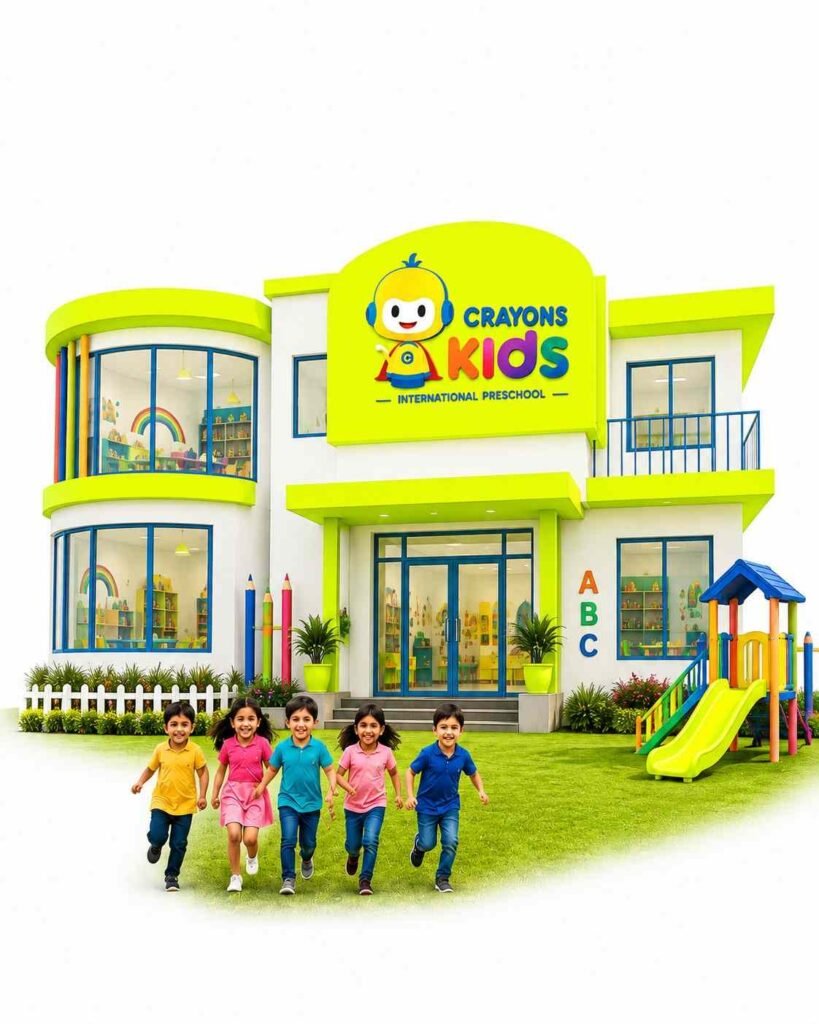
At Crayons Kids, we believe that the best days are the ones children cannot stop telling you about, even if it takes them a week to start. Our teachers create classrooms filled with songs, stories and gentle attention, so that every child has something wonderful to share at bedtime.
If you are searching for a preschool where your child’s smallest words and biggest moments are noticed and celebrated, we would love to welcome your family. Book a campus visit today, meet our teachers, and see for yourself why so many parents trust us with the moments they cannot see. Enquire about admissions today.