
Blogs
The Day My Baby Didn’t Need Me to Eat
For three years, I fed my son with my own hands.
I did it at the dining table, on the sofa, on the balcony while he pointed at crows, and once, memorably, in the back of a taxi stuck in traffic. I knew how to hide a spoonful of rice inside a story about a brave rabbit. I knew which songs bought me three extra bites, and which cartoon bought me five. Feeding him was never just about food. It was our small, daily ritual of closeness, and I was very, very good at it.
So when I unzipped his lunchbox at the end of his first week of preschool and found it completely empty, I assumed there had been some mistake.
The Empty Lunchbox
I turned the box over. I checked the lid. I looked inside his water bottle, as though it might be hiding a stray piece of chapati. Nothing. Every grain of rice, every piece of carrot, every little square of omelette I had packed that morning was gone.
My son stood beside me, swinging his school bag and humming a tune I did not recognise. “Did somebody help you eat?” I asked, trying to keep my voice light.
He looked at me with the patient expression of a person who has been asked a very silly question.
“No, Amma,” he said. “I ate myself.”
I stared at him. “All of it?”
“All of it.” He lifted his chin with great dignity. “Teacher said I am a big boy.”
I smiled and said something encouraging, I think. I do not remember. What I remember is a strange, quiet drop in my chest, as though someone had gently removed a small stone I had been carrying for so long that I no longer noticed its weight.
Pride With a Hollow in the Middle
I want to be honest about what I felt, because I think many parents feel it and few admit it.
I was proud. Of course I was. This was exactly what I had hoped for. Every parenting article I had read told me that independent eating was a healthy milestone, a sign of growing confidence and motor skill. I had wanted this day. I had practised for it, in my own clumsy way, by letting him hold his spoon at home and trying not to wince at the mess.
But underneath the pride, there was a hollow. A small, specific, unexpected ache.
Because I understood, standing there with that empty lunchbox in my hands, that I had just been quietly retired from a job I had loved. Not completely. He would still need me for a thousand things. But this one, the very first thing I had ever done for him in the early, sleepless days, the act that had once been the centre of my entire world, no longer required me.
My baby had eaten without me. And he had not even noticed that I was gone.
What Feeding Had Really Meant
I have thought a great deal since about why this particular milestone struck me so hard.
I think it is because feeding is the oldest form of love we have. Before a baby can speak, before he can smile at you properly, before he knows your name, he knows your milk, your arms, your voice saying “one more bite.” Feeding is how a mother says, I will keep you alive, and I will do it gently.
For three years, that had been my most direct language. When he was sick, I fed him. When he was cranky, I fed him. When the world was too loud and too large, I fed him, and he leaned against me, and the world grew small and warm again.
Now he was telling me, in the plainest possible way, that he could take care of himself. And I understood that I would have to find new languages for love.
How It Happened Without Me
The next day, I asked his teacher about it, half embarrassed, half hungry for detail. How had a child who needed to be coaxed through every meal at home managed to finish an entire lunch alone?
She smiled, in the way teachers do when they know exactly what you are feeling.
“It is the table,” she said. “At school, they all sit together. Nobody is watching him. Nobody is begging him to take another bite. He looks at the child beside him, who is eating, and he simply does the same. Children are wonderfully good at copying each other.”
She told me that on his first day, he had watched the others for a full ten minutes, spoon in hand, before taking his first bite. On the second day, a little girl beside him had said, “Yummy!” and he had laughed and finished everything in front of him. By the third day, he was asking for a second helping of curd.
“He is not eating for us,” she added gently. “He is eating because it is something the big children do. That is the best reason in the world.”
I thought about that for a long time. At home, I had been the only audience. At school, he had a whole room of tiny role models. He had found a kind of motivation that I, with all my songs and stories, had never quite been able to provide.
What I Had to Learn to Do Instead
Learning to step back was harder than I expected. For the first few weeks, I instinctively reached for his spoon at dinner, and he would pull it away with a firm, “No, I do it!” It was a small, polite rebellion, and every time, I had to sit on my hands.
Slowly, I developed new habits.
I sat with him instead of feeding him. Mealtimes became about conversation, not coordination. He told me about the boy who disliked peas, the girl who always dropped her roti, the day the teacher sang a song about a hungry caterpillar. I discovered that the table was still our place. We had simply changed the activity.
I let the mess happen. Rice on the floor. Dal on the shirt. A very surprising quantity of curd in his hair. I told myself that every spill was evidence of learning, and I kept a damp cloth nearby and my sense of humour closer.
I praised the effort, not the finish. “You held your spoon so carefully,” I told him, instead of “good boy for eating.” It changed the way he talked about food. He began to describe his own meals with pride.
I found new rituals. Our evening cuddle story, previously a post-dinner feeding routine, became simply a story. I realised he still wanted my lap. He just no longer needed it to be fed.
The Night He Fed Me
The moment that finally softened the ache came about a month later.
I was tired after a long day, sitting on the sofa with a plate of rice and a headache. My son climbed up beside me, studied my face with great seriousness and announced, “Amma, you did not eat.”
“I am eating, beta.”
“No. Your plate is full.” He picked up the spoon from my plate, scooped up a small, careful amount of rice and held it up to my mouth. “Open.”
I stared at him. Then I laughed, helplessly, and opened my mouth.
He fed me one spoonful. Then another. He did it exactly the way I had done it for him: slowly, gently, with an encouraging murmur of “good, one more.” When I had finished, he patted my arm and said, “Now you are strong.”
I put my plate down and held him until he began to squirm.
I understood, then, what I had not been able to see through the sadness. I had not been retired. I had been succeeded. The love I had spent three years pouring into him had not disappeared when he learned to feed himself. It had taken root. And it was now growing outward, toward me.
What Independent Eating Really Gives a Child
I have since learned that this small milestone carries more significance than I had ever imagined.
When a young child feeds himself, he is practising fine motor control, hand and eye coordination, and the first, quiet building blocks of self-trust. He is learning to listen to his own hunger and fullness. He is discovering that he can meet a need without asking someone else to do it for him.
That sense of “I can do this” is not limited to food. It travels. A child who masters his own spoon is a little more willing to try buttoning his shirt, zipping his bag, tying his shoes. Each small success feeds the next, and the habit of independence slowly, steadily grows.
What I did not expect was how much of this growth would happen in a classroom, among other children, under the patient watching of teachers who understood that the best way to help a child grow is often to step back and let him try.
Why the Right Preschool Makes This Easier
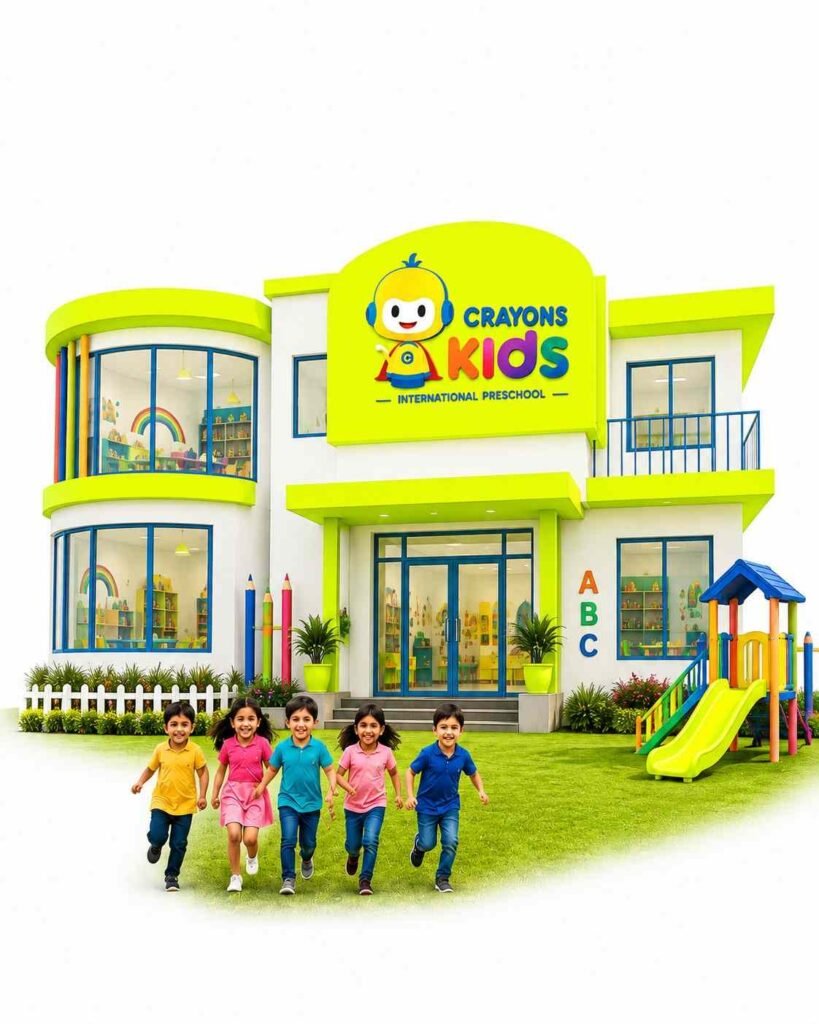
Looking back, I am grateful that this milestone happened at Crayons Kids, where mealtime is treated not as an interruption to learning, but as part of it.
Teachers sit with the children. They notice who is hesitant, who is picky and who needs a little encouragement, without ever turning the table into a battleground. There is no pressure, no bribery, no forced bites. There are simply small groups, gentle routines and plenty of room for children to discover that eating can be fun when nobody is making a fuss.
That atmosphere gave my son something I could not give him alone: the freedom to try, the company of friends and the pride of doing something by himself. And it gave me the reassurance of knowing that, even when I was not there, he was being cared for with patience.
If you are searching for a play school that supports your child’s independence while keeping them safe and nurtured, that is exactly the quality worth looking for.
To Every Parent Holding an Empty Lunchbox
If your own child has recently stopped needing your help at the table, I hope you will allow yourself both feelings: the pride and the ache. They are not a contradiction. They are the double heartbeat of good parenting.
You have done your job well. You fed your child until he could feed himself. You gave him the safety to try, the patience to fail and the love to keep going. That empty lunchbox is not a loss. It is a receipt, proof that everything you poured in has been received.
And one day, perhaps sooner than you expect, a small hand will hold up a spoon to your mouth and say, “Open.”
Give Your Child Room to Grow, With Someone Watching Kindly
At Crayons Kids, we believe that every small step toward independence deserves to be celebrated, from the first spoon to the first friend to the first brave goodbye. Our teachers guide children gently, keep families informed and treat your trust as the precious thing it is.
If you are searching for a preschool where your child can grow confident, capable and happy, we would love to welcome your family. Book a campus visit today, meet our teachers, and see for yourself how we help every child find their own way, one proud spoonful at a time. Enquire about admissions today.